


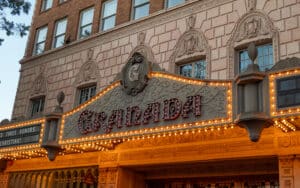
Photo Courtesy of Visit Santa Barbara
Theater is ancient. The musical is not. As the modern musical approaches its 100th birthday in 2027, The Granada Theatre celebrates this ever-evolving art form, which comes to life each season with the American Theatre Guild’s touring Broadway productions at The Granada.
The Rise of The Modern Musical
When Oscar Hammerstein’s Show Boat debuted in 1927, it ushered in an entirely new form of live performance.
Before Show Boat, live entertainment in the United States was dominated by vaudeville. This variety-style show of singers, dancers, and comedians had no unifying story. Many performers, composers, lyricists, and producers who later shaped Broadway got their start in vaudeville, helping lay the groundwork for the American musical theater tradition. When The Granada opened in 1924, it hosted many variety and vaudeville shows featuring the day’s top performers, while musical acts accompanied silent film screenings. The theater continued to present this type of entertainment throughout the 1920s, with acts such as the Dancing Dolls appearing on its stage in 1929.
But the theatrical landscape was changing. When Oscar Hammerstein II’s Show Boat debuted in 1927, it helped usher in an entirely new form of live performance, one that integrated music, characters, and story into a unified whole.
Hammerstein continued his trailblazing in 1943 when he teamed with Richard Rodgers on Oklahoma!, the first of their 11 musical collaborations. This production built on Show Boat’s innovation by adding choreography to the story. This is the template that’s still used by musicals today.
Together, these landmark productions helped shift musical theater away from spectacle-driven variety acts and toward character-driven storytelling, setting the stage for many of the musicals audiences enjoy today.
The Golden Age
For two decades after Oklahoma!, musicals were the backbone of Broadway’s Golden Age. Musicals were the most popular shows on Broadway, and they became synonymous with American theater.
Rodgers and Hammerstein led the way with iconic productions including Carousel, South Pacific, The King and I, and The Sound of Music. This era also saw the debuts of Irving Berlin’s Annie Get Your Gun, Alan Jay Lerner and Frederick Loewe’s My Fair Lady, and Leonard Bernstein and Stephen Sondheim’s West Side Story. These productions proved that the musical could encompass everything from Shakespeare and pointed commentary to lighter entertainment.
Shows during the Golden Age were lavish affairs built for large houses and featured elaborate sets, big casts, and full orchestras. And the productions weren’t contained to Broadway; successful musicals toured the country. Oklahoma!’s national tour ran nearly a decade, stopping in over 360 cities worldwide. It also helped popularize the original cast album, changing how theater was mass-marketed.
Concept Musicals & Rock Restructure the Mold
With the cultural upheavals of the 1960s, the sunny musical of the past didn’t always reflect changing audience tastes, and two new trends emerged.
In the mid-60s, Cabaret introduced a new structure with the concept musical. Instead of a linear plot, concept musicals were centered around an idea or theme. Cabaret explored a turbulent period in history, while Stephen Sondheim shows like Company and Sweeney Todd took the genre even further in the 1970s.
As popular music flourished during this time, rock left the concert stage and leaped to Broadway. In 1968, Hair shocked traditional theater-goers with its loose plot and rock score. Jesus Christ Superstar and Pippin continued the trend and introduced a new generation to live theater.
The British Mega Musical
While Broadway in the 1970s made the musical more intimate and experimental, London’s West End embraced spectacle in the 1980s.
Led by Andrew Lloyd Webber, mega musicals like Cats, Les Misérables, The Phantom of the Opera, and Miss Saigon became global sensations. Known for their sung-through scores, ambitious stagecraft, and memorable theatrical effects, these productions demonstrated that musicals could be international blockbuster entertainment. Their success also transformed how Broadway and West End productions were marketed, toured, and merchandised around the world.
Jukebox Rock
At the turn of the 21st century, producers found success building shows around catalogs of existing hit songs. Mamma Mia! proved the model worked, paving the way for productions such as Jersey Boys, Rock of Ages, MJ the Musical, and & Juliet.
While critics have debated the artistic merits of jukebox musicals, they continue a long Broadway tradition of using popular music to bring audiences into the theater.
The Musical Today
One of the most significant shifts in 21st-century musicals came from Hamilton, which reimagined what a showtune could be by blending rap, pop, and R&B with a story adapted from a scholarly book on the founding fathers.
Hamilton paved the way for Hadestown to rework a Greek myth as a folk and blues musical, Six to turn Henry VIII’s wives into a girl group, and Dear Evan Hansen to delve into teenage isolation and social media with contemporary pop music.
Today, Broadway embraces a wide range of musical styles and storytelling approaches. Musicals aren’t defined by one sound or style.
The Granada is Santa Barbara’s Musical Home
Throughout its 100-year history, the modern musical’s innovation has been that it’s never a single fixed sound. It looks to popular culture, using the music of the day to tell profound stories.
At The Granada, a wide range of musicals, from The Book of Mormon’s satire to Cyndi Lauper’s hits in Kinky Boots, have graced the stage. The touring infrastructure that brings Hadestown from a Broadway stage to Santa Barbara traces back to the same model that sent Oklahoma! across the country in the 1940s. Broadway in Santa Barbara, presented through the American Theatre Guild, is the modern version of the road that has existed since the Golden Age.
As the musical turns 100 in 2027, The Granada Theatre remains proud to bring this ever-evolving art form to Santa Barbara audiences. To learn more about upcoming performances and events at The Granada Theatre, please visit the theater’s website at https://www.granadasb.org/