


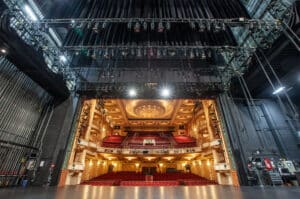
It’s Saturday, and the production team at The Granada Theatre is preparing the theater for a dance production that uses older, traditional lighting. Not only is the lighting hard to find today, but it also requires the crew to swap out the cutting-edge lighting technology from the show the night before. Stephanie Boshers, Director of Stage Production & Operations, helps coordinate the many moving pieces that make these transitions possible. As part of her role coordinating productions and supporting the theater’s technical team, Boshers spends months communicating with touring companies to understand their needs and identify solutions.
This production whiplash is par for the course at a historic theater that is constantly adapting to meet the changing technical demands of live performance. One night may require cutting-edge lighting and sound technology, while the next may call for traditional equipment that has been used for decades. Supporting both is part of what has driven The Granada’s technological evolution for more than a century.
Always on the Cutting Edge
Since its inception, The Granada has consistently invested in the technology of its era, evolving to meet the changing needs of performers and audiences.
When the theater opened in 1924, it had a state-of-the-art Wurlitzer organ to provide live sound effects and a score for silent films. Stage technology of this era meant live musicians and a very large, very mechanical instrument doing the work that speakers and playback systems do now.
In 1955, when The Granada was bought by the Metropolitan Theater Company, 70 mm projection capability was added.
The 2008 Renovation
The massive renovation The Granada completed in 2008 marked the most significant technology transformation in the theater’s history.
According to Boshers, the technical team and resident companies played an important role in shaping many of the renovation decisions.
“The resident companies required a minimum of a 50-foot-wide proscenium, which the theater did not have, as well as a minimum stage depth that we could not accommodate,” she explained. “The decision was made to remove the back portion of the building and fundamentally reshape the stage house, extending the stage and widening the proscenium to meet those needs.”
The Granada stages a wide variety of performances with unique acoustic requirements, so different sound treatments were incorporated into the renovation. During orchestral or opera performances, you’ll see beautiful “birdbaths” throughout the space and decorative tiles on the walls that appear to be set at slightly different angles, which you won’t see at a rock-and-roll show. During amplified performances, acoustical curtains are lowered throughout the auditorium to dampen the room and absorb some of the sound that would otherwise reflect off hard surfaces. Those reflective surfaces are important during an acoustic performance because they help project and distribute the natural sound of an orchestra or opera throughout the room.
“It’s a great example of how the theater was designed to transform depending on what is happening onstage,” said Boshers.
From a more technical standpoint, many touring productions require lots of independent electrical service, so improved electrical infrastructure was installed.
“Ultimately, the renovation was about looking beyond what the companies were asking for at that moment and considering what they might need in the future,” Boshers said. “We tried to build as much flexibility into the building as possible and make our best prediction about what would be required for the theater to remain a relevant and adaptable performing arts venue in 2026 and beyond.”
Pioneering Sound System
The renovation created a more flexible performance space, but technological innovation at The Granada did not stop there.
The Granada created theater history when it became the first theater in the world to debut the AeroWave® system in 2021. Former Granada board member Allen Sides, legendary multi-Grammy award-winning engineer, producer, and founder of Ocean Way Audio, believed he could solve the sound problems that The Granada had historically struggled with.
He and his team reimagined what theater sound could be and created a sound system that distributes sound equally throughout The Granada.
Current Technological Upgrades
Despite trying to foresee the future during its major renovation, advances inevitably emerged that weren’t expected.
“I like to say that with a 20-year-old theater comes 50-year-old problems,” joked Boshers. “Theater technology moves quickly. Just a few years ago, everyone was evaluating LED lighting technology and questioning whether it was ready for everyday professional use. Fast-forward to today, and we can not only find high-quality white-light LED fixtures but also instruments capable of replicating the gel colors that have been a staple of our industry for decades.”
The Granada and its production team are currently undertaking a multi-year lighting modernization project that includes upgrading house lighting and control dimming systems and replacing lighting control consoles.
Moving Forward
“Hybrid laser lighting, immersive video mapping, augmented reality (AR), and virtual reality (VR) may all seem cutting-edge today, but I suspect that in 20 years they will feel like an average Tuesday in the theater world,” said Boshers.
The production crew works hard to prepare for future technologies by building the infrastructure, flexibility, and technical capabilities that will allow the adaptation of these technologies as they become more accessible.
“The next frontier may not be something we can name today, but we want the Granada to be in a position to embrace it when it arrives,” she says.
Whether supporting traditional productions that rely on legacy equipment or embracing emerging technologies that have yet to become mainstream, The Granada’s production team remains committed to creating a theater that is prepared for whatever comes next.